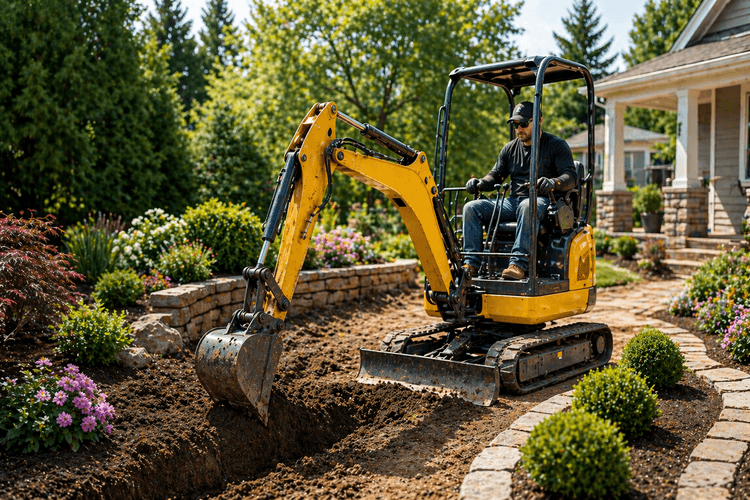
Revolutionizing Construction: Mini Excavators for Power
11 Min read

January 20, 2024
In the ever-evolving landscape of construction and excavation, size is no longer a limitation but a strategic advantage. Enter the world of mini excavators, compact powerhouses that have revolutionized the way we approach digging, trenching, and earthmoving tasks. In this exploration, we will delve into the significance of mini excavators, uncovering their versatile capabilities and the transformative impact they bring to construction sites around the globe. From their compact design to their exceptional performance, mini excavators are proving that when it comes to solving big challenges in tight spaces, these small machines are the answer.
Compact Marvels
Mini excavators, often referred to as compact marvels, are precisely what their name implies-scaled-down versions of their larger counterparts with a specific focus on maneuvemaneuverabilityrability in confined spaces. These diminutive powerhouses have redefined the possibilities in construction, providing unmatched versatility and efficiency. Their compact size is a strategic advantage, enabling them to access tight and restrictive areas that would be impractical or impossible for larger equipment. Their diminutive footprint makes mini excavators indispensable in urban construction projects where space is at a premium.
Related Equipment
Browse all Mini Excavators


Whether it's excavating trenches for utilities, landscaping in residential areas, or performing precision work on crowded job sites, mini excavators excel where larger machines cannot tread. What truly sets these compact marvels apart is their hydraulic systems, which, despite their size, deliver a remarkable combination of precision and force. Operators can confidently navigate tight spaces with finesse, all while exerting significant digging and lifting power. This exceptional control ensures that excavation work is not only efficient but also exceptionally accurate, meeting project specifications with the utmost precision.
Versatile Workhorses

From the precision of digging trenches and foundations to the finesse of grading and the strength of material handling, mini excavators have demonstrated their prowess in a myriad of applications. One of their defining features is the ability to accommodate various interchangeable attachments, such as buckets for digging, augers for drilling, hydraulic hammers for breaking, and more. These attachments transform mini excavators into multifunctional tools, extending their utility across different projects.
Whether it's a landscaping project, urban construction, utility work, or excavation tasks, mini excavators are equipped to efficiently and effectively take on the challenge. Their adaptability not only saves time and labour but also enhances cost-effectiveness, as one machine can perform multiple functions with ease.
The versatility of mini excavators has elevated them to the status of indispensable assets in the construction industry. Their ability to seamlessly transition between tasks, coupled with their precision and compact design, makes them an ideal choice for modern construction projects where efficiency, adaptability, and cost-effectiveness are paramount.
Compact, but Robust - The Resilience of Mini Excavators
Mini excavators, despite their small stature, are engineered for durability and dependability in the harshest work environments. Their robust construction, coupled with durable components and reinforced tracks, underscores their longevity and unwavering reliability. These compact machines are designed to tackle demanding tasks day in and day out, making them a steadfast presence on construction sites worldwide. Their sturdy frames and well-engineered components ensure they can withstand the rigours of excavation, earthmoving, and utility work without faltering.
Mini excavators excel in challenging conditions, proving their resilience when faced with demanding construction challenges. Whether it's digging in rocky terrain, navigating through tight spaces, or enduring exposure to the elements, these machines consistently deliver unwavering performance. Their reinforced tracks provide stability and traction, allowing them to manoeuvre across uneven terrain with ease. Moreover, their hydraulic systems and controls enable operators to maintain precision and efficiency, even in adverse conditions.
In the world of construction, where durability is essential, mini excavators stand as a testament to compact yet robust machinery. These diminutive powerhouses are a symbol of reliability, ensuring that construction projects progress smoothly and efficiently, regardless of the challenges they encounter.
Efficiency and Precision
They stand out in the construction and excavation industry for their exceptional efficiency and precision. These compact machines are renowned for their ability to provide precise and controlled excavation, making them indispensable assets in various projects. At the heart of their precision lies their responsive hydraulic systems. Mini excavators are equipped with advanced hydraulic controls that allow operators to navigate tight spaces with finesse. This responsiveness means that operators can manipulate the machine's movements with a high degree of accuracy, ensuring that every excavation or digging task is carried out with precision.
Operators can avoid accidental damage to surrounding buildings, utilities, or landscaping features. This precise control not only enhances safety on the job site but also minimizes costly repairs and delays. Furthermore, the efficiency of mini-excavators cannot be overstated. Their compact design and hydraulic systems allow for swift and effective excavation, reducing project timelines and labour costs. This efficiency, combined with their precision, ensures that excavation work meets project specifications with exceptional accuracy.
Hence, mini-excavators are at the forefront of modern construction due to their remarkable efficiency and precision. Their ability to operate with finesse in tight spaces, coupled with their responsiveness, makes them the preferred choice for tasks demanding accuracy and control. Whether it's digging trenches, foundations, or utility work, mini excavators consistently deliver results that meet project specifications with the utmost precision and efficiency.
Cost-Effective Solutions
Mini excavators represent a paradigm shift in the construction and excavation industry, offering highly cost-effective solutions that benefit both small-scale and large-scale projects alike. Their cost-efficiency arises from multiple facets of their design and operation. First and foremost, the compact size of mini excavators plays a pivotal role in reducing costs. Unlike larger heavy machinery, these nimble powerhouses require less extensive site preparation. Their ability to access tight or confined spaces means that site modification and clearance work can be minimized or even eliminated.
This translates into substantial savings in both time and labour costs, streamlining project timelines and budgets. Furthermore, mini excavators are renowned for their fuel efficiency. Equipped with modern, eco-friendly engines, these machines consume significantly less fuel compared to their larger counterparts. This not only reduces operating costs but also aligns with environmental sustainability goals, contributing to a greener construction industry.
Maintenance is another area where mini excavators excel in cost-effectiveness. Their relatively simple design and robust construction translate into lower maintenance requirements.
Reduced downtime for repairs and maintenance means more uptime for productivity on the job site, ultimately driving down operational costs. Hence, mini excavators are cost-effective solutions that transcend project scales. Their compactness minimizes site preparation, while fuel efficiency and low maintenance contribute to long-term affordability. These financial advantages, coupled with their versatility and precision, make mini excavators a smart choice for construction projects where efficiency and budget-consciousness are paramount.
How Much Does a Mini Excavator Cost?
Mini excavator prices vary based on brand, model, operating weight, age, operating hours, condition, specifications, attachments, and market conditions.
Used machines can range from relatively low-cost compact models to substantially more expensive construction-grade machines. Current Boom & Bucket listings demonstrate this variation, with examples including smaller Bobcat and Caterpillar machines and larger Takeuchi models at significantly different prices.
When comparing prices, consider:
Purchase price
Operating hours
Maintenance history
Undercarriage condition
Attachments
Repair requirements
Transportation costs
Expected service life
Resale value
The lowest asking price is not necessarily the lowest total cost of ownership.
Buying a Used Mini Excavator
When buying a used mini excavator, evaluate condition, operating hours, maintenance history, hydraulic performance, undercarriage wear, and attachment compatibility.
Inspect:
Engine and cooling system
Hydraulic system
Boom and arm
Cylinders and hoses
Tracks and undercarriage
Pins and bushings
Swing bearing
Frame
Controls and electrical system
Hour meter
Service and repair records
A well-maintained machine with higher hours can be a better purchase than a lower-hour machine with poor maintenance records.
Used Mini Excavator Inspection Checklist
Use this checklist before purchasing a used mini excavator:
Engine
Starting performance
Smoke or unusual noise
Fluid leaks
Cooling system
Hydraulics
Cylinder leaks
Damaged hoses
Hydraulic response
Pump performance
Undercarriage
Track condition
Idlers
Sprockets
Track tension
Related Equipment
Browse all Mini Excavators


Structure
Boom and arm
Welds
Cracks
Bucket condition
Swing system
Excessive play
Unusual noise
Leakage
Documentation
Serial number
Operating hours
Maintenance records
Repair history
If possible, operate the machine and have a qualified technician perform a pre-purchase inspection.
Mini Excavator Maintenance
Follow the manufacturer's maintenance schedule and regularly inspect:
Engine oil and filters
Hydraulic fluid and filters
Coolant
Hydraulic hoses
Grease points
Pins and bushings
Track tension
Rollers and sprockets
Attachments
Cooling system
Regular preventive maintenance can help reduce unexpected downtime and identify wear before it develops into a larger repair.
How to Choose the Right Mini Excavator
Choose a mini excavator based on the work, not simply the machine's horsepower or operating weight.
Consider:
Digging depth: Can the machine reach the required excavation depth?
Access: Will its width and tail swing fit the jobsite?
Lifting: Can it safely handle the materials you need to move?
Hydraulics: Can it power your required attachments?
Production: Is the bucket and machine size appropriate for the workload?
Transportation: Can you legally and economically move it between jobs?
Terrain: Will the undercarriage and machine configuration suit the site?
Budget: Does the purchase price fit your total ownership costs?
For many residential, landscaping, utility, and trenching applications, a compact machine in the 3- to 5-ton range can provide a useful balance of maneuverability and capability, but the correct size depends on the actual project requirements.
Used Mini Excavators for Sale
Used mini excavators are available in a wide range of makes, models, sizes, operating hours, attachments, conditions, and prices.
When comparing listings, look at:
Make and model
Year
Operating hours
Operating weight
Digging depth
Hydraulic specifications
Attachments
Undercarriage condition
Service history
Location
Price
Don't compare asking prices alone. Consider the machine's condition, specifications, remaining service life, and expected repair costs.
Frequently Asked Questions
What is a mini excavator?
A mini excavator is a compact tracked excavation machine designed for digging, trenching, grading, lifting, demolition, and material handling in areas where larger machines may not fit.
What are mini excavators used for?
Mini excavators are commonly used for trenching, landscaping, utility work, drainage, residential construction, grading, demolition, and material handling.
What size mini excavator should I buy?
Choose based on digging depth, operating weight, machine width, lift capacity, attachment requirements, transportation, and jobsite access.
How deep can a mini excavator dig?
Maximum digging depth varies by model and configuration. Check the manufacturer's specifications for the exact machine.
Are mini excavators good for landscaping?
Yes. Their compact size, maneuverability, and attachment options make them useful for grading, trenching, planting, drainage, and other landscaping tasks.
Is a mini excavator better than a skid steer?
A mini excavator is generally better for digging and trenching, while a skid steer is better suited to grading, loading, material handling, and many attachment-based tasks.
Are used mini excavators worth buying?
They can be, particularly when the machine has good maintenance records, acceptable wear, suitable specifications, and a price that reflects its condition.
What should I inspect on a used mini excavator?
Inspect the engine, hydraulics, boom, cylinders, tracks, undercarriage, pins, bushings, swing system, attachments, controls, operating hours, and service records.
Conclusion
Mini excavators represent a transformative force in the construction and excavation industry, embodying the notion that size is no longer a constraint but a strategic advantage. Their compact design, combined with unmatched versatility, operational efficiency, and cost-effectiveness, has reshaped the landscape of modern construction.
These small machines deliver exceptional precision and power, allowing them to excel in confined spaces and urban environments where larger equipment would struggle. Their hydraulic systems provide responsive and controlled operation, minimizing the risk of damage to surrounding structures, enhancing safety, and reducing costly repairs.
Mini excavators are versatile workhorses that effortlessly switch between various tasks, thanks to their interchangeable attachments, making them indispensable for a wide range of projects. Their efficiency, fuel economy, and reduced maintenance requirements contribute to long-term affordability, aligning with sustainability goals and budget-consciousness.
In a world where construction demands are ever-evolving, mini excavators have emerged as dependable allies, offering innovative solutions to the challenges of modern excavation projects. They have effectively broken down spatial limitations and proven that even in tight spaces, they possess the capability to excavate, lift, and transform landscapes with precision and power, setting new standards of excellence in the industry.


Related Articles
More in Insight