How to Find the Best Used Off-Highway Truck for Sale
9 Min read
&w=3840&q=75)

January 5, 2023
Finding the best used off-highway truck for sale starts with more than comparing prices, model years, or operating hours. The right truck needs to match your application, payload requirements, terrain, haul distance, production goals, and maintenance budget.
Used off-highway trucks can provide substantial value when properly inspected and matched to the job. However, two trucks with similar hours can have very different levels of wear depending on their previous duty cycle, maintenance history, load conditions, and operating environment.
This guide explains how to choose a used off-highway truck, what to inspect before buying, how to evaluate operating hours, and how to determine whether a machine offers good long-term value.
What Is an Off-Highway Truck?
%3Aformat(webp)&w=1920&q=75)


An off-highway truck is a heavy-duty truck designed primarily to transport material across construction sites, mines, quarries, and other off-road environments rather than public highways.
The two major categories buyers commonly encounter are articulated dump trucks (ADTs) and rigid-frame haul trucks.
Articulated dump trucks use an articulation joint between the front and rear sections, giving them strong maneuverability on rough, uneven, and challenging terrain. Rigid-frame haul trucks are designed for high-capacity material movement and are commonly used in large-scale mining and quarry applications.
The right choice depends on the job—not simply the truck's size or rated payload.
How to Choose the Right Used Off-Highway Truck
Start by defining the conditions in which the truck will operate.
Consider:
Type and density of material
Typical payload
Haul distance
Road conditions
Grades and slopes
Ground conditions
Loading equipment
Required production rate
Expected operating hours
Available service and parts support
A truck that works well on a well-maintained quarry haul road may not be the best choice for a muddy construction site with steep grades and rough terrain.
Match Payload to the Application
Payload is one of the most important specifications when choosing an off-highway truck.
For example, current articulated dump truck models span substantially different payload classes. John Deere's current lineup includes models ranging from approximately 53,000 lb of rated payload to more than 92,000 lb, demonstrating why buyers should select capacity based on the application rather than assuming that a larger truck is automatically better.
Your target payload should be considered alongside:
Material density
Bucket capacity
Number of loading passes
Haul distance
Cycle time
Terrain
Truck availability
An oversized truck can increase acquisition, tire, fuel, and maintenance costs without improving productivity if the rest of the operation cannot efficiently load or utilize it.
Consider the Loading Equipment
The truck and loading machine should work as a system.
An excavator or wheel loader that requires too many passes to fill a truck can slow production. On the other hand, using a loading machine that consistently overloads a truck can increase component stress and operating risk.
The goal is an efficient match between loader capacity, truck payload, cycle time, and haul distance.
Articulated vs. Rigid Off-Highway Trucks
Choosing between an articulated dump truck and a rigid-frame haul truck is one of the biggest decisions you'll make.
%3Aformat(webp)&w=1920&q=75)
The best option depends on your site conditions and production requirements. Current ADT specifications also show how payload, power, and body capacity vary significantly across models, so buyers should compare machines by application rather than relying on truck size alone.
How Many Hours Are Too Many on a Used Off-Highway Truck?
There is no universal operating-hour limit that makes an off-highway truck a good or bad purchase.
Operating hours should be evaluated together with the machine's duty cycle, maintenance history, component condition, and previous application.
When reviewing a used truck, look at:
Total engine hours
Idle hours where available
Transmission hours
Previous application
Typical payload
Haul-road conditions
Maintenance intervals
Engine rebuild history
Transmission work
Differential and final-drive repairs
Hydraulic-system repairs
Tire history
A truck with more hours but excellent maintenance and documented component work may provide better value than a lower-hour truck that operated in severe conditions and received poor maintenance.
Understand the Duty Cycle
Hours don't tell the entire story.
Ask how the truck was used:
What material did it haul?
Rock, aggregate, soil, overburden, and other materials can create different wear conditions.
How long were the haul cycles?
Short, repetitive cycles can place different demands on components than longer transport cycles.
What terrain did it encounter?
Steep grades, deep ruts, mud, and rough haul roads can increase stress on drivetrain, suspension, steering, and tires.
Was it regularly loaded to capacity?
Operating near maximum payload can create a different wear profile than lighter-duty applications.
Understanding the machine's history helps put its hour meter into context.
How to Inspect a Used Off-Highway Truck
%3Aformat(webp)&w=1920&q=75)
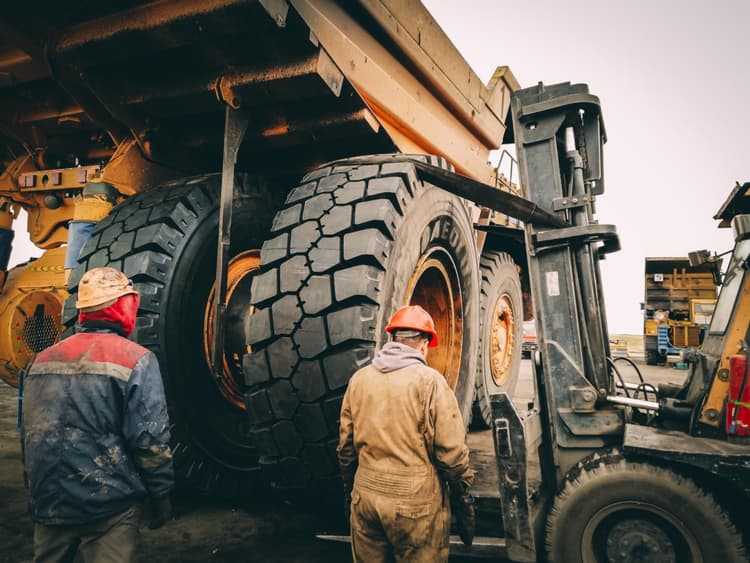
A professional pre-purchase inspection is one of the most important steps when buying used heavy equipment.
Don't rely only on photographs, paint condition, or the seller's description. Expensive mechanical problems can exist underneath an otherwise clean exterior.
Inspect the Engine
Look for:
Oil or coolant leaks
Excessive smoke
Abnormal engine noise
Blow-by
Warning lights or fault codes
Cooling-system problems
Service history
Rebuild or replacement history
If possible, evaluate the machine during a cold start. A cold-start inspection can reveal problems that may be less apparent after the engine reaches operating temperature.
Check the Transmission and Drivetrain
Inspect the transmission for abnormal shifting, leaks, unusual noises, and evidence of poor maintenance.
Also inspect:


Driveshafts
Differentials
Axles
Final drives
Wheel ends
Universal joints
Drivetrain repairs can be expensive, so evidence of previous component work should be included when evaluating the truck's overall value.
Inspect the Articulation Joint
For an articulated dump truck, the articulation system deserves special attention.
Inspect:
Center pins
Bushings
Bearings where applicable
Steering cylinders
Hydraulic lines
Joint movement
Cracks
Lubrication condition
Excessive play or damage around the articulation joint can indicate significant wear and potential repair costs.
Examine the Frame and Dump Body
Look carefully for:
Cracks
Weld repairs
Structural deformation
Corrosion
Damage around mounting points
Excessive wear
Inspect the dump body for worn floors, damaged sidewalls, cracks, hydraulic-cylinder problems, and previous repairs.
Check Brakes, Suspension, and Tires
Inspect braking and retarding systems, suspension components, tires, and wheels before buying.
Look for:
Uneven tire wear
Cuts or sidewall damage
Leaks
Cracked suspension components
Worn bushings
Damaged mounts
Brake-system issues
For large haul trucks, braking and retarding performance are especially important when operating on grades.
Review Maintenance and Equipment History
Maintenance records can reveal more about a used off-highway truck than age or hours alone.
Request available records for:
Preventive maintenance
Engine service
Transmission service
Differential and final-drive work
Hydraulic repairs
Brake repairs
Tire replacements
Major component rebuilds
Inspections
Pay particular attention to recent major repairs. A truck that has recently received substantial component work may have a different ownership outlook than one approaching several major service intervals.
Also verify the machine's identification numbers and documentation before completing the transaction.
How to Determine the Value of a Used Off-Highway Truck
The purchase price is only one part of the equation.
Compare the asking price with:
Model and year
Operating hours
Payload capacity
Previous application
Component condition
Maintenance history
Recent rebuilds
Tire condition
Dump-body condition
Articulation condition
Parts availability
Service support
Current market demand
Then calculate the likely total cost of ownership.
Consider:
Purchase price + transportation + inspection + immediate repairs + tires + expected maintenance + fuel + potential downtime
A truck with a lower purchase price isn't necessarily the better deal if it immediately needs major drivetrain, hydraulic, tire, or articulation repairs.
Get an Independent Pre-Purchase Inspection
For a significant equipment purchase, consider having a qualified heavy-equipment technician inspect the truck independently.
The inspection should ideally include:
Visual inspection
Cold-start evaluation
Diagnostic scan
Fluid checks
Road or site test
Engine evaluation
Transmission evaluation
Frame inspection
Articulation inspection
Hydraulic-system inspection
Brake and retarder inspection
Tire and wheel inspection
Ask for major defects to be documented along with estimated repair costs. That information can help you negotiate the purchase price or decide whether another machine represents better value.
Used Off-Highway Truck Buying Checklist
Before purchasing, confirm that you have:
Defined the truck's intended application
Determined the required payload
Evaluated terrain and haul distance
Matched the truck to the loading equipment
Reviewed operating hours and duty cycle
Checked maintenance records
Inspected the engine and transmission
Inspected the drivetrain
Checked the articulation system on an ADT
Inspected the frame and dump body
Evaluated brakes and retarding systems
Checked suspension and tires
Verified equipment identification and documentation
Completed an independent inspection
Estimated immediate repair costs
Calculated total cost of ownership
Compared the machine with similar used trucks
Frequently Asked Questions
What is the best used off-highway truck?
The best used off-highway truck depends on the application. Articulated dump trucks are generally well suited to rough or uneven terrain where maneuverability is important, while rigid-frame haul trucks are better suited to high-volume operations with established haul roads. Payload, terrain, cycle time, maintenance history, and total ownership cost should guide the decision.
What should I look for when buying a used off-highway truck?
Focus on payload, operating hours, duty cycle, maintenance history, engine and transmission condition, drivetrain, frame, articulation system, dump body, hydraulics, brakes, suspension, tires, and overall repair requirements. A professional pre-purchase inspection is strongly recommended.
How many hours is too many on an off-highway truck?
There is no universal hour limit. Evaluate operating hours alongside duty cycle, maintenance history, component condition, previous application, and recent rebuilds. A well-maintained higher-hour truck can sometimes offer better value than a poorly maintained lower-hour machine.
How do I determine the value of a used off-highway truck?
Compare the asking price with the truck's age, hours, payload, condition, maintenance history, component repairs, tires, previous application, and current market demand. Then estimate transportation, immediate repairs, maintenance, fuel, and potential downtime to determine the machine's total ownership cost.
Final Takeaway
The best used off-highway truck for sale isn't necessarily the newest, lowest-hour, or cheapest machine.
The right truck is the one that matches your payload, terrain, application, production requirements, and operating budget while providing a documented maintenance history and sound mechanical condition.
Start by determining whether an articulated dump truck or rigid-frame haul truck fits your operation. Then evaluate payload, duty cycle, operating hours, engine and drivetrain condition, articulation or frame condition, tires, brakes, hydraulics, and maintenance records.
Most importantly, don't judge a used off-highway truck by its hour meter alone. Understanding how the machine was used and maintained provides much better insight into its remaining value.
With a thorough inspection and a realistic total-cost analysis, you can identify a used off-highway truck that delivers the capability and productivity your operation needs without paying for capacity you don't actually use.
Ready to Compare Used Off-Highway Trucks?
Once you know your required payload, operating conditions, and budget, the next step is comparing machines that fit your application. Boom & Bucket makes it easier to research used heavy equipment by giving buyers access to detailed equipment listings and information in one place.
Browse used off-highway trucks on Boom & Bucket and compare available machines based on specifications, hours, condition, and application.


Mike Kennedy is Boom & Bucket's Marketplace Operations Manager, where he leads shipping, warranties, and post-sale operations to create a seamless buyer experience. As one of the company's earliest team members, Mike helped build the foundation of Boom & Bucket's operations and guided its growth through acquisition by RB Global. He is passionate about scaling marketplaces, solving operational challenges, and improving efficiency to deliver industry-leading results.