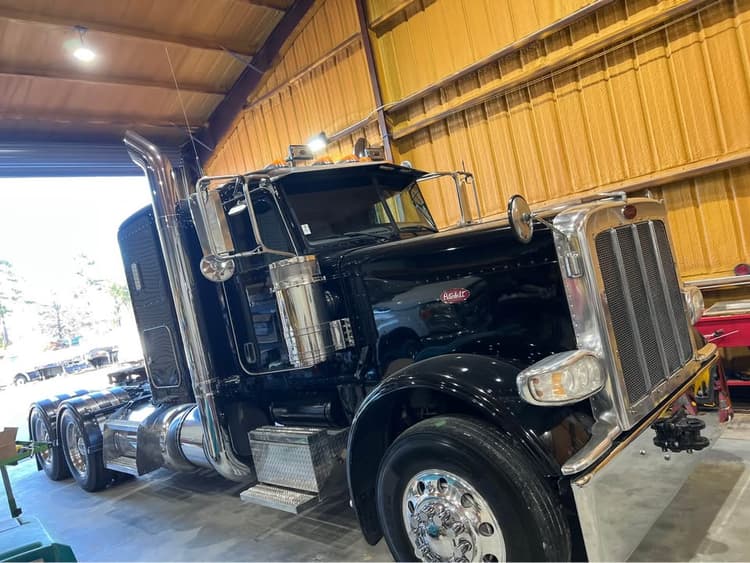
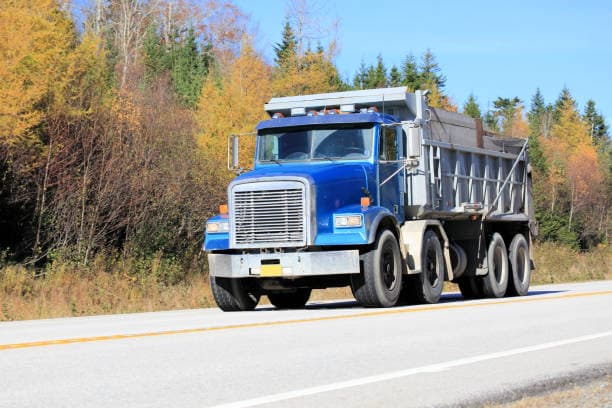
Different Types of Dump Trucks and Their Uses
10 Lectura mínima
&w=3840&q=75)

mayo 30, 2023
Dump trucks are essential for moving bulk materials such as soil, gravel, sand, rock, asphalt, demolition debris, and construction waste. But not all dump trucks are built for the same job.
The right dump truck depends on where you are working, how much material you need to move, the type of material being hauled, road conditions, and how the truck will unload its load.
Common configurations include standard dump trucks, super dump trucks, transfer dump trucks, side dump trucks, end dumps, bottom dumps, articulated dump trucks, and rigid haul trucks. Some are designed for public roads, while others are built specifically for off-road construction, quarry, and mining applications.
This guide explains the major types of dump trucks, what each one is used for, and what to consider when choosing a used dump truck for your operation.
What Is a Dump Truck?
%3Aformat(webp)&w=1920&q=75)
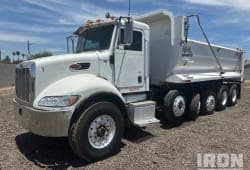
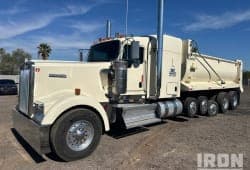
A dump truck is a vehicle designed to transport loose materials and unload them using a powered dump body or trailer.
Most dump trucks use a hydraulic system to raise or tilt the body, allowing the material to slide out. The unloading configuration varies by truck.
For example, an end dump raises the front of the body and discharges material from the rear, while a side dump tilts its body to unload beside the truck. A bottom dump opens gates underneath the trailer to release material from the bottom.
The basic purpose is the same: move material efficiently from one location to another and unload it quickly.
9 Types of Dump Trucks
1. Standard Dump Truck
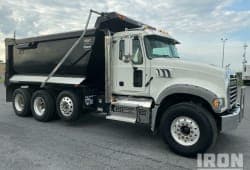
The standard dump truck is one of the most common configurations for construction and general hauling.
It typically consists of a truck chassis, cab, rear dump body, and hydraulic lifting system. The body raises at the front and dumps material through the rear.
Common uses include:
Residential and commercial construction
Road construction
Landscaping
Excavation
Gravel and sand hauling
Demolition cleanup
General material transportation
Standard dump trucks are useful when a contractor needs a versatile truck that can travel between public roads and jobsites.
Their relatively compact configuration also makes them practical where maneuverability is important.
2. Super Dump Truck
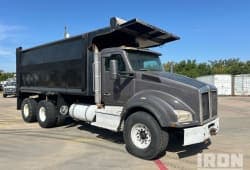
A super dump truck is a high-capacity dump truck configuration that uses a trailing axle behind the main rear axles.
The additional axle helps increase the truck's allowable payload under applicable regulations. The trailing axle can also be lifted when the truck is empty, depending on the configuration.
Super dumps are often used when contractors need to move more material per trip while remaining within applicable weight requirements.
Typical applications include:
Asphalt hauling
Sand and aggregate
Road construction
Large commercial projects
General construction material hauling
Because payload regulations vary by jurisdiction, operators should always verify applicable weight limits before loading.
3. Transfer Dump Truck
A transfer dump truck combines a standard dump truck with a separate detachable dump container or trailer.
The truck can carry the additional container, allowing the operator to transport more material without requiring a larger conventional truck.
Transfer trucks are particularly useful for longer hauling distances where additional capacity can improve productivity.
Common applications include:
Construction
Road building
Aggregate hauling
Asphalt
Dirt and sand
Large earthmoving projects
The ability to separate the truck and trailer also provides operational flexibility.
4. Side Dump Truck
A side dump truck unloads material by tipping its body to the side instead of raising it vertically at the front.
This configuration can provide fast unloading and can be useful when there is limited room behind the truck. Side dumps are also useful for certain road construction and aggregate applications.
Common uses include:
Road construction
Aggregate hauling
Earthmoving
Mining and quarry work
Embankment construction
Because the material is discharged to the side, operators need to account for ground conditions, clearance, and stability during dumping.
5. Semi-Trailer End Dump Truck
A semi-trailer end dump consists of a road tractor pulling a dump trailer.
The trailer is raised hydraulically from the front, allowing material to discharge through the rear.
This configuration can provide substantial hauling capacity while maintaining the flexibility of a tractor-trailer setup.
Common applications include:
Construction
Aggregate hauling
Asphalt
Sand and gravel
Demolition
Large material-hauling projects
One important consideration is the dumping area. Raising a loaded trailer changes the truck's center of gravity, so the unloading surface needs to be appropriate for the operation.
6. Semi-Trailer Bottom Dump Truck
Bottom dump trucks, sometimes called belly dumps, discharge material through gates located underneath the trailer.
Rather than raising the entire trailer, the operator opens the bottom gates and releases material onto the ground.
This makes bottom dumps especially useful for spreading material in controlled windrows.
Typical applications include:
Road construction
Road base
Aggregate placement
Sand
Gravel
Large-scale earthmoving
Bottom dumps can be particularly productive when material needs to be distributed continuously rather than dumped into a single pile.
Configurations can include single, double, and triple trailers, although additional trailers can reduce maneuverability and require appropriate operating conditions.
7. Articulated Dump Truck
%3Aformat(webp)&w=1920&q=75)
An articulated dump truck (ADT) is an off-highway truck with a pivoting joint between the front tractor section and rear dump body.
This articulation allows the machine to maneuver over rough, uneven, muddy, or steep terrain.
Articulated trucks are widely used in:
Construction
Mining
Quarrying
Road building
Land development
Large-scale earthmoving
Their articulation and drivetrain configuration make them particularly useful when haul roads are rough or constantly changing. Caterpillar, for example, lists articulated trucks specifically for steep grades, rough terrain, and poor haul conditions.
Payload varies considerably by model. Current Cat articulated truck models range from the 725 at 26.5 U.S. tons to the 745 at 45.2 U.S. tons.
8. Rigid Haul Truck
Rigid haul trucks are large off-highway dump trucks designed for high-volume hauling.
Unlike articulated trucks, they have a fixed frame rather than a center articulation joint.
They're commonly used in:
Large surface mines
Quarries
Major earthmoving projects
Large construction sites
Rigid trucks can carry very large payloads and are generally most effective where haul roads are designed and maintained for high-capacity equipment. Caterpillar notes that off-highway trucks are designed for quarry, aggregate, mining, and construction applications, particularly on well-maintained haul roads.
9. Winter-Service Dump Truck
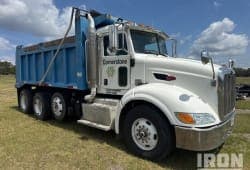
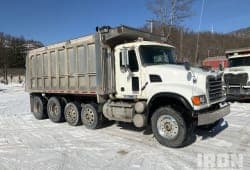
A dump truck can also be configured for winter maintenance.
These trucks may carry salt, sand, or other spreading materials and can be equipped with snowplows for clearing roads.
Typical applications include:


Snow removal
Salt spreading
Sand spreading
Municipal road maintenance
Parking lot maintenance
This is a specialized configuration rather than a completely different dump-truck chassis, making it important to distinguish between the base truck and its application-specific equipment.
Dump Truck Types Compared
Choosing between dump truck types starts with understanding where and how each configuration works best.
%3Aformat(webp)&w=1920&q=75)
How to Choose the Right Dump Truck
The cheapest truck isn't necessarily the most productive truck. Start with the job rather than the purchase price.
Consider Payload
Determine how much material you need to move per cycle.
A truck with a larger payload may reduce the number of trips required, but only if the loading equipment, haul road, and regulations support that capacity.
Consider Material
Different materials have different densities.
A dump body that can hold a large volume may reach its weight limit before it is physically full when hauling dense rock or aggregate.
Consider Haul Distance
Short-haul and long-haul applications can favor different configurations.
For longer distances, payload, road speed, fuel consumption, and cycle time become increasingly important.
Consider Terrain
For rough, steep, muddy, or uneven jobsites, an articulated dump truck may be more appropriate than a conventional highway dump truck.
For large mines with engineered haul roads, rigid haul trucks may be more appropriate.
The important point is that truck selection should match the complete hauling environment, not simply the advertised payload.
Consider Loading Equipment
Your dump truck should work efficiently with the excavator or wheel loader loading it.
If the truck is too small, it may require too many cycles. If it's too large for the loading equipment, the truck may spend too much time waiting.
Matching truck payload to loader bucket capacity and cycle time can improve overall fleet productivity.
What to Check When Buying a Used Dump Truck
Buying used can provide access to productive equipment at a lower acquisition cost, but condition matters more than the age of the truck alone.
Before buying, inspect:
Engine: Check for leaks, excessive smoke, unusual noises, and maintenance history.
Transmission and drivetrain: Test shifting, listen for abnormal noises, and inspect differentials, axles, and final drives where applicable.
Hydraulics: Check cylinders, hoses, fittings, and the hydraulic system for leaks or damage.
Dump body: Look for cracks, excessive wear, corrosion, damaged floors, and previous repairs.
Frame: Inspect the frame and structural components for cracks, deformation, or evidence of major repairs.
Tires: Examine tread, sidewalls, uneven wear, and remaining service life.
Brakes and steering: These systems are critical, particularly on heavily loaded trucks operating on grades.
Hours and service records: Operating hours provide useful context, but maintenance history and previous application are equally important.
For off-highway equipment, also inspect the articulation joint, suspension, differentials, and undercarriage components where applicable.
How Many Cubic Yards Can a Dump Truck Carry?
Dump truck capacity varies significantly by truck size, body configuration, and material density.
A truck's volume capacity and weight capacity are not the same thing.
For example, a body may physically hold a certain volume of material, but dense rock could cause the truck to reach its payload limit before the body is full.
That means contractors should evaluate both:
Cubic-yard capacity
Rated payload
The correct truck is the one that can legally and efficiently carry the required material for your specific application.
Why Buy a Used Dump Truck?
%3Aformat(webp)&w=1920&q=75)
Used dump trucks can make sense for contractors and fleet managers who need additional hauling capacity without purchasing new equipment.
A used machine can be particularly attractive when:
You need to expand fleet capacity.
A project requires additional trucks temporarily.
You want a backup hauling unit.
You're entering a new market.
Your operation doesn't require the newest technology.
Purchase price is an important part of the equipment decision.
However, the purchase price should only be the beginning of the evaluation.
Consider fuel consumption, tires, maintenance, repairs, financing, transportation, and expected utilization when estimating the machine's total cost of ownership.
Frequently Asked Questions
What are the main types of dump trucks?
Common types include standard, super dump, transfer, side dump, semi-trailer end dump, bottom dump, articulated dump trucks, rigid haul trucks, and specialized winter-service dump trucks.
What type of dump truck is best for construction?
It depends on the project. Standard dump trucks work well for general construction, while articulated dump trucks are often suited to rough off-road earthmoving. Large projects may require higher-capacity end dumps or off-highway haul trucks.
What is the difference between an articulated and rigid dump truck?
An articulated dump truck has a pivoting joint between its front and rear sections, improving maneuverability on rough terrain. A rigid haul truck uses a fixed frame and is generally suited to established haul roads and high-volume hauling.
What is a bottom dump truck used for?
Bottom dump trucks release material through gates underneath the trailer. They're commonly used for road construction, aggregate placement, and applications where material needs to be spread in a controlled pattern.
Are dump trucks good for mining?
Yes, depending on the mining application. Articulated and rigid haul trucks are both used in mining, but the appropriate choice depends on payload, haul-road conditions, terrain, haul distance, and production requirements.
Should I buy a new or used dump truck?
A used dump truck can provide a lower initial purchase cost, but buyers should evaluate machine condition, service history, hours, tires, drivetrain, hydraulics, and expected repair costs before purchasing.
Find the Right Used Dump Truck for Your Operation
The right dump truck can make a major difference in how efficiently your crew moves material.
Before buying, start with the fundamentals: What are you hauling? How far are you hauling it? What is the terrain like? How much material needs to move per day? What equipment will load the truck?
Once you know those answers, you can narrow your search to the dump truck configuration that fits the work.
Ready to add hauling capacity to your fleet?
Explore used dump trucks on Boom & Bucket to compare available equipment based on specifications, hours, condition, and price.
Need to spread the purchase over time? Explore equipment financing options to help fit the machine into your equipment budget.
Found the right truck but need to get it to your jobsite? Arrange equipment transportation and keep the purchase moving from seller to site.
And if you're building a complete earthmoving fleet, consider pairing your dump truck with a used excavator, wheel loader, bulldozer, or motor grader to create a better-matched material-handling operation.
Browse used heavy equipment from Boom & Bucket and find the dump truck that fits the job-not just the price tag.


Samir Shah is the Co-Founder and Chief Product Officer of Boom & Bucket, where he leads the development of innovative solutions for buying and selling heavy equipment. With a background in engineering, product development, and business strategy, Samir has a track record of taking companies from concept to market success. Previously, he was the Head of Cat Digital Labs at Caterpillar, overseeing digital initiatives and product launches. He holds degrees from MIT Sloan and Carnegie Mellon, and he is passionate about tackling big challenges in underserved industries.