Front-End Loaders: Uses, Types, Benefits & Buying Guide
11 Lectura mínima


junio 20, 2023
A front-end loader is one of the most versatile machines on a construction site, farm, quarry, or material-handling operation. Also commonly called a wheel loader, it uses a front-mounted bucket or attachment to scoop, lift, transport, load, and stockpile materials.
From moving gravel at a construction site to clearing snow from a commercial parking lot, front-end loaders can handle a wide range of jobs. Their combination of mobility, lifting capacity, and attachment versatility makes them valuable for contractors and fleet managers who need one machine to perform multiple tasks.
But choosing the right front-end loader requires more than comparing horsepower or bucket size. The machine should match your material, jobsite conditions, required production, operating space, attachments, transportation needs, and budget.
This guide explains what front-end loaders do, the different types available, their most common applications, and what to look for when buying a used machine.
What Is a Front-End Loader?

Equipo reciente
Examinar todas las equipo


A front-end loader is a heavy equipment machine designed primarily to scoop, lift, carry, and load loose materials. The machine typically has a bucket mounted to hydraulic lift arms at the front and a wheeled chassis that allows it to move efficiently around a jobsite.
Front-end loaders are particularly effective when a project requires repeated material movement rather than deep excavation. Common materials include:
Dirt and soil
Sand
Gravel
Crushed aggregate
Rock
Construction debris
Snow
Mulch
Wood chips
Agricultural materials
Unlike an excavator, which is primarily designed for digging with a boom and arm, a front-end loader excels at moving material over relatively short distances and loading trucks or stockpiles.
The existing Boom & Bucket guide similarly distinguishes loaders from excavators based on their primary functions: loaders are generally optimized for material movement, while excavators are designed for digging.
How Does a Front-End Loader Work?
The machine's hydraulic system powers the loader arms and bucket. An operator drives the loader into a material pile, fills the bucket, raises the arms, and carries the load to its destination.
A typical loading cycle involves:
Approaching the material pile.
Positioning and filling the bucket.
Reversing away from the pile.
Carrying the material.
Raising the loader arms to the required height.
Dumping the material into a truck, hopper, stockpile, or other location.
Returning for the next cycle.
Productivity depends on more than bucket capacity. Travel distance, material density, loading height, operator skill, site layout, and machine size all affect how much material a loader can move during a shift.
That is why the biggest machine isn't necessarily the most productive machine for every application.
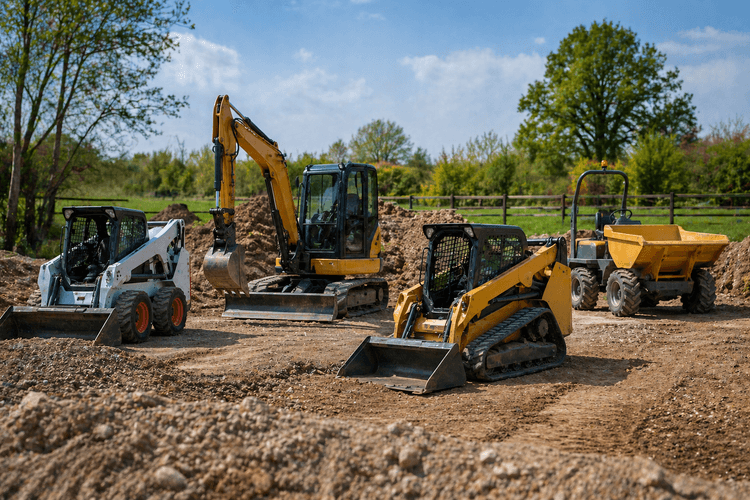
Common Types of Front-End Loaders
Front-end loaders come in several configurations. The right type depends on the terrain, material, available space, and workload.
Wheel Loaders
Wheel loaders are the most common type of front-end loader. They use tires rather than tracks, giving them good mobility on firm surfaces.
They're widely used for:
Construction
Aggregate handling
Quarrying
Mining
Landscaping
Agriculture
Snow removal
Waste handling
Wheel loaders are especially effective when operators need to travel between loading and dumping locations. Boom & Bucket's existing equipment guidance identifies wheel loaders as a strong choice for general versatility and material-handling work.
Track Loaders
Track loaders use continuous tracks instead of wheels. The tracked undercarriage provides additional flotation and traction on soft or uneven ground.
They can be useful for:
Rough terrain
Land clearing
Heavy material handling
Site preparation
Construction work on challenging ground
However, track loaders aren't always the best choice when a job requires frequent travel across paved or hard surfaces.
Skid Steer Loaders
Skid steer loaders are compact, highly maneuverable machines that can work in relatively confined spaces. Their wide range of attachments makes them popular for construction, landscaping, demolition, and property maintenance.
Their smaller size can be an advantage when access is limited, although they generally don't offer the same bulk-material capacity as larger wheel loaders.
Compact Wheel Loaders
Compact wheel loaders bridge the gap between small loaders and larger production machines. They're useful for landscaping, construction, snow removal, agriculture, and material handling where maneuverability is important.
They can also be easier to transport between smaller jobsites than larger wheel loaders.
Front-End Loader Applications
The versatility of a front-end loader comes from its ability to perform repeated loading and material-handling tasks while using different buckets and attachments.
1. Construction
Construction is one of the most common applications for front-end loaders.
Contractors use them to:
Move dirt and aggregate
Load dump trucks
Backfill areas
Stockpile material
Prepare sites
Clean up construction debris
A loader can become particularly productive when positioned close to a material pile and haul trucks.
2. Aggregate and Quarry Operations
Quarries and aggregate operations require machines capable of moving large quantities of material efficiently.
Wheel loaders can load:
Sand
Gravel
Crushed stone
Limestone
Other bulk aggregates
Bucket capacity, breakout force, operating weight, tire selection, and cycle times become increasingly important as production requirements increase.
3. Agriculture
Front-end loaders are useful on farms and ranches for moving feed, manure, soil, bedding, hay, and other materials.
With the appropriate attachment, a loader can perform tasks beyond conventional bucket work, helping agricultural operations get more value from one machine.
4. Landscaping
Landscaping contractors can use compact and mid-size loaders to move:
Topsoil
Mulch
Gravel
Sand
Decorative stone
Plants and materials
Compact wheel loaders can be especially useful when the machine needs to maneuver around buildings, landscaping features, or established property.
5. Snow Removal
Front-end loaders are frequently used for commercial and municipal snow removal.
A suitable bucket or snow attachment allows operators to push, scoop, pile, and load snow. Their mobility can make them useful for clearing large parking lots, roads, loading areas, and commercial properties.
6. Waste and Recycling
Waste facilities use loaders to move and organize bulk materials. Specialized attachments can increase versatility for material handling and sorting applications.
Machine configuration is particularly important in demanding waste environments because debris, dust, and abrasive materials can increase wear.
7. Material Handling
Front-end loaders can move bulk materials around yards, stockpiles, processing facilities, and industrial sites.
Depending on the loader and attachment, applications may include loading trucks, feeding processing equipment, moving aggregate, and organizing stockpiles.
Front-End Loader Attachments
The bucket is only the starting point.
The right attachment can significantly expand what a front-end loader can accomplish. Common options include:
General-Purpose Bucket
A general-purpose bucket is a practical choice for dirt, sand, gravel, aggregate, and everyday loading work.
Light-Material Bucket
Light-material buckets provide greater volume for lower-density materials such as snow, mulch, wood chips, and similar products.
Rock Bucket
Heavy-duty rock buckets are designed for abrasive materials and demanding aggregate applications.
Forks
Fork attachments can turn a loader into a material-handling machine for pallets, bundled products, and other loads when the machine and attachment are appropriately rated.
Grapples
Grapples can be useful for handling logs, brush, demolition debris, and irregular materials.
Boom & Bucket's wheel-loader attachment guide emphasizes an important point: attachment selection should account for machine capacity, hydraulic requirements, material, coupler compatibility, and jobsite conditions rather than simply whether the attachment physically fits.
Front-End Loader vs. Excavator: Which Is Better?
Neither machine is universally better. The right choice depends on the work.

Equipo reciente
Examinar todas las equipo


If your operation spends most of the day loading trucks, moving aggregate, or stockpiling material, a wheel loader may be the better fit.
If the primary job is digging foundations, trenches, or deep excavations, an excavator is generally the more appropriate machine.
Many contractors ultimately use both because their capabilities complement each other.
How to Choose the Right Front-End Loader

Buying the right loader starts with the work rather than the machine's brand.
1. Define Your Application
Determine exactly what the loader will do most often.
Ask:
What materials will it handle?
How much material must it move per hour?
How far will it travel?
How high must it lift?
What surface will it operate on?
How frequently will it work?
2. Match Bucket Capacity to the Material
Bucket size affects production, but a larger bucket isn't automatically better.
Dense materials such as rock and wet aggregate can quickly increase payload weight. The bucket must remain within the machine's rated operating limits.
For lighter materials, a larger-volume bucket may make better use of the machine's available capacity.
3. Consider Lift Height
If you're loading dump trucks, hoppers, or other elevated targets, make sure the loader can reach the required dump height.
Don't rely solely on maximum lift specifications. Check the machine's actual clearance and working range for the bucket or attachment you intend to use.
4. Evaluate Maneuverability
Consider your available working area.
A large production loader may be ideal in a quarry but inefficient in a confined construction site. Compact machines can offer better maneuverability when working around buildings, landscaping, or other obstacles.
5. Calculate Total Ownership Costs
Purchase price is only part of the equation.
Budget for:
Fuel
Tires
Preventive maintenance
Repairs
Insurance
Transportation
Attachments
Financing
Downtime
A cheaper machine can become expensive if it requires frequent repairs or isn't productive enough for your workload.
Why Consider a Used Front-End Loader?
Buying used heavy equipment can provide contractors with a way to add production capacity without paying the price of a new machine.
A used front-end loader can make sense when:
You need additional fleet capacity.
You're expanding into material-handling work.
Your current loader is nearing replacement.
You want a machine for seasonal work.
You need a second loader for a busy jobsite.
Your budget doesn't justify buying new.
However, condition matters more than age alone.
What to Inspect Before Buying a Used Front-End Loader
Before purchasing, inspect the machine carefully.
Engine
Check for leaks, excessive smoke, unusual noises, difficult starting, and inconsistent performance.
Hydraulic System
Inspect hoses, cylinders, pumps, fittings, and connections for leaks or damage. Test the loader arms and bucket through their operating range.
Transmission
Test forward and reverse operation and pay attention to unusual noises, hesitation, or rough shifting.
Articulation Joint
On articulated wheel loaders, inspect the center articulation area for excessive play, wear, or damage.
Tires
Tire condition can have a significant effect on operating costs. Check tread depth, sidewalls, uneven wear, and visible damage.
Bucket and Linkage
Inspect cutting edges, bucket corners, pins, bushings, lift arms, and welds.
Service History
When available, review maintenance records and compare reported operating hours with the machine's overall condition.
A professional inspection can also be worthwhile when you're evaluating a higher-value used loader.
Is a Front-End Loader a Good Investment?

A front-end loader can be a strong investment when the machine is consistently utilized.
The key question isn't simply, "How much does the loader cost?"
Instead, ask:
How much productive work can this machine generate over its useful life?
If a loader regularly replaces rented equipment, reduces labor requirements, improves loading productivity, or allows your business to accept additional work, ownership may provide significant value.
On the other hand, if the machine will sit idle for most of the year, renting may be a better financial option.
Calculate expected utilization before making the purchase.
Frequently Asked Questions
What is a front-end loader mainly used for?
A front-end loader is primarily used to scoop, lift, transport, stockpile, and load loose materials such as dirt, gravel, sand, aggregate, snow, and debris.
Is a front-end loader the same as a wheel loader?
In many equipment discussions, yes. "Front-end loader" and "wheel loader" are commonly used to describe wheeled machines with front-mounted loader arms and buckets.
What industries use front-end loaders?
Construction, mining, quarrying, agriculture, landscaping, waste management, snow removal, and material-handling operations all commonly use front-end loaders.
Can a front-end loader dig?
A front-end loader can perform some digging and excavation-related tasks, but it is primarily designed for scooping and moving material. An excavator is generally better suited for deep digging and trenching.
What attachments can a front-end loader use?
Depending on the machine, attachments can include general-purpose buckets, light-material buckets, rock buckets, forks, grapples, snow attachments, and other specialized tools.
Should I buy a new or used front-end loader?
The right choice depends on your budget, utilization, required specifications, and risk tolerance. A properly inspected used loader can provide substantial capability while reducing upfront acquisition costs.
Find Your Next Used Front-End Loader
A front-end loader can be one of the most productive machines in a construction or material-handling fleet-but only when its size, configuration, bucket, and capabilities match the work.
Start by defining your application, material, production requirements, operating environment, and budget. Then compare machines based on condition and total ownership cost rather than purchase price alone.
Ready to put a front-end loader to work?
Explore the selection of used wheel loaders and heavy equipment available through Boom & Bucket to find machines that fit your operation.
Browse Used Equipment
Compare available loaders by make, model, year, hours, price, and location.
Looking for a specific machine? Use Boom & Bucket's equipment marketplace to narrow your search and find equipment suited to your application.
Need Financing?
Once you've found the right machine, explore available financing options to determine how the purchase can fit your equipment budget and cash flow.
Need Transportation?
Don't forget the final step: getting the machine to your jobsite. Consider transportation requirements, equipment dimensions, weight, and delivery costs when calculating the total purchase investment.
The right loader isn't necessarily the biggest one or the cheapest one. It's the machine that can consistently perform the work your business needs.


Aaron Kline is the Co-Founder and COO of Boom & Bucket, where he leverages his extensive leadership experience to revolutionize the heavy equipment industry. With a background in building scalable processes and teams from his time as a Naval officer and executive roles in tech, Aaron focuses on introducing cutting-edge technology to construction and agriculture markets. Before Boom & Bucket, he held leadership positions at Skylo and Yard Club (acquired by Caterpillar), and he’s passionate about fostering innovation and driving efficiency in under-digitized industries.